
For many clients, one of the biggest challenges in speech therapy is generalizing learned strategies from structured practice to spontaneous conversation. Voiceitt, an AI-powered speech recognition app designed for people with non-standard or impaired speech, can serve as an effective bridge by giving communicators real-time feedback that mirrors real-world communication.
Using Voiceitt for Real-Time Biofeedback
When a Voiceitt communicator speaks into the app, Voiceitt will always respond, either accurately or with an imperfect transcription. Those imperfect transcriptions create valuable opportunities for therapy. The communicator can review the output, identify where clarity broke down, and apply targeted speech strategies such as:
– Slowing down to improve pacing
– Making space between words for clearer word boundaries
– Articulating with precision and increased mouth awareness
– Using consistent breath support to maintain stable vocal quality
Voiceitt functions as a natural biofeedback mechanism, helping communicators connect how they speak with how well they are understood. This process reinforces self-awareness, self-correction, and the transfer of strategies learned in therapy.
Case Example: J, a 14-Year-Old Voiceitt Communicator
J is a 14-year-old student who often begins her utterances with extended vocalic fillers like “um” and “so.” She also tends to produce a continuous vocalic stream throughout her speech, leaving few natural breaks between words, which can make speech recognition systems less accurate. As a result, Voiceitt sometimes became confused about word boundaries, leading to inaccurate transcriptions.
Although J is literate, she initially found the on-screen transcriptions distracting and preferred not to see them while she spoke. With her SLP’s guidance, she began using the textual feedback as a learning tool. Whenever Voiceitt generated an incorrect transcription, she paused and made a communication repair, implementing her targeted speech strategies on the second attempt.
A simple visual support, a large yellow pause button taped to her Tobii Dynavox, the device she uses to run Voiceitt, served as a reminder to pause, breathe, and reset before repeating her message. Over time, this integration of tactile, visual, and auditory cues not only improved Voiceitt’s transcription accuracy and dictation success but also enhanced J’s intelligibility for both familiar and unfamiliar listeners.
Flexible Modes for Different Communicators
Depending on individual literacy and sensory needs, SLPs can customize how feedback is delivered through Voiceitt:
– Preliterate or blind communicators can use Speak Mode, which automatically reads the transcription aloud to support auditory feedback and self-monitoring.
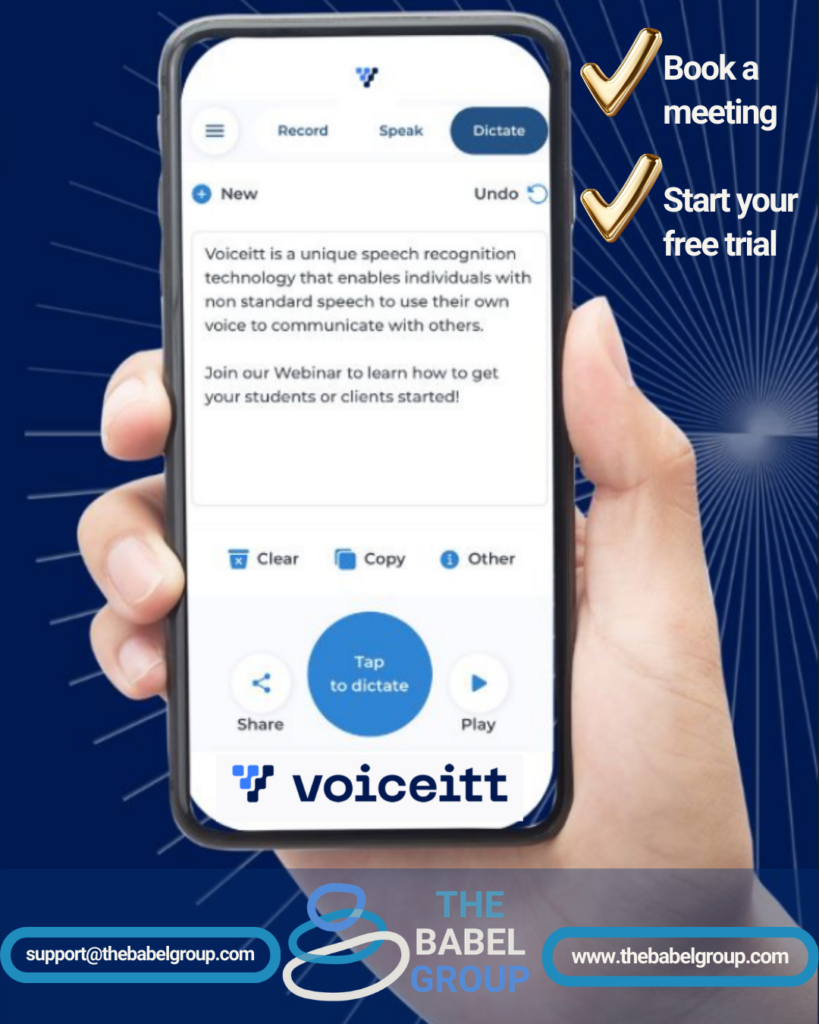
– Literate communicators can use Dictate Mode to view the transcribed text, providing visual feedback for error detection and targeted strategy use.
These options allow clinicians to adapt Voiceitt to diverse therapy contexts, including home practice, teletherapy, and school-based sessions.
Integrating Technology Into Clinical Practice
For SLPs, Voiceitt provides an easy way to extend therapy beyond structured sessions. It reinforces breath support, pacing, and articulation goals while promoting functional, self-directed communication.
As demonstrated in J’s case, combining Voiceitt with existing supports, such as visual cues and AAC tools, can yield measurable improvements in intelligibility and overall communicative confidence. With the right guidance, Voiceitt transforms from a speech recognition app into a valuable clinical partner in building clear, confident, and empowered communicators.
Partner with The Babel Group
The Babel Group works with clinicians, schools, and assistive technology teams to integrate tools like Voiceitt into therapy and daily communication. To learn more about training, implementation support, or collaboration opportunities, contact us at The Babel Group website www.thebabelgroup.com or email support@thebabelgroup.com.
Using Voiceitt is improving my breath support, pacing and confidence!