

By Dr. Rachel Levy, SLPD, CCC-SLP
When people hear that Voiceitt works best for speech with consistent patterns, a common follow-up question is whether it can still help individuals with an apraxia diagnosis. The short answer is: sometimes, yes, and understanding why requires a closer look at how apraxia and speech consistency actually work.
Understanding the Challenge of Apraxia
Childhood apraxia of speech (CAS) is a motor planning disorder. The speaker knows what they want to say, but the brain has difficulty planning and sequencing the movements needed to produce speech. This often results in variable errors, disrupted prosody, and reduced intelligibility, especially to unfamiliar listeners.
Because Voiceitt is a personalized speech recognition system that learns a user’s unique speech patterns, variability can make training more complex. However, variability does not mean the absence of patterns.
Consistency Still Exists in Apraxia
Even in apraxia, speech is not random. Many individuals show consistent patterns within specific phonemic contexts, syllable shapes, or word structures. For example, a sound may be produced inconsistently across different words, but consistently distorted within a familiar phrase or context.
This is where Voiceitt can sometimes succeed. The system does not require speech to match “standard” pronunciation. Instead, it learns how that individual produces speech, as long as there is enough consistency for the model to learn from.
A Key Question: Are Familiar Listeners Understanding the Speaker?
One of the most important predictors of success with Voiceitt for someone with apraxia is this question:
Is the individual understood by familiar listeners (parents, caregivers, teachers, therapists)?
If familiar listeners can understand the speaker with some degree of reliability, that level of intelligibility provides a realistic benchmark for what Voiceitt may be able to achieve. In many cases, Voiceitt’s performance can approximate the accuracy of familiar listeners.
If speech is largely unintelligible even to familiar partners, Voiceitt is less likely to be effective at this stage.
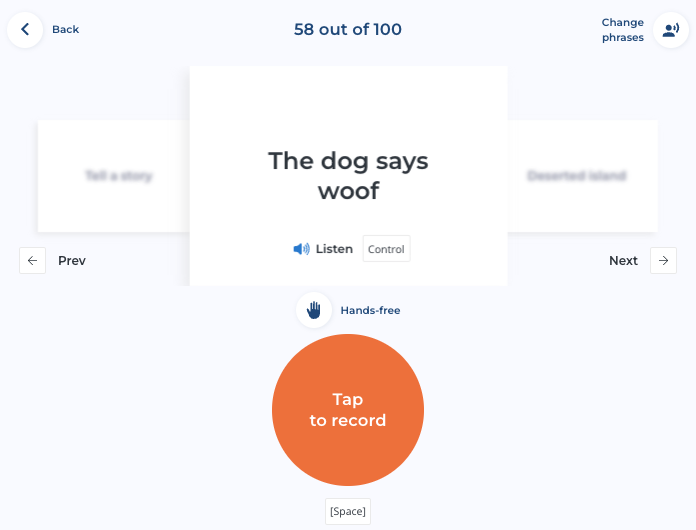
How Many Recordings Are Needed?
Another common question is:
“How many recordings will I need before Voiceitt starts to understand me?”
There is no fixed number, but a general principle applies:
The further speech is from standard production, the more recordings Voiceitt will require.
For individuals with apraxia, this often means:
-
- More phrases need to be recorded
-
- Slower progress early in training which means you may need to record many phrases before seeing progress
-
- Choosing the right phrases sets (they can be chosen in the “record” section0
That said, progress is not always linear. Once Voiceitt begins to recognize patterns, accuracy can improve more quickly.
Setting Realistic Expectations
Voiceitt is not a replacement for speech therapy, and it is not the right solution for every individual with apraxia. However, for individuals who demonstrate:
-
- Some consistency within phonemic contexts
-
- Functional intelligibility with familiar listeners
-
- The ability to repeat phrases
Voiceitt can become a meaningful communication support, increasing independence and reducing communication breakdowns.
Measuring Progress Matters: Don’t Skip the Data
When working with individuals with apraxia, determining whether Voiceitt is a viable long-term solution depends heavily on how progress is measured. Because improvement is often gradual and non-linear, informal impressions alone can be misleading.
If you are trialing Voiceitt with a student or client and asking questions like:
-
- Is accuracy improving over time?
-
- Are more words being consistently recognized?
- Is performance stabilizing after each training level?