
Voiceitt Training Data: Proof for District Funding
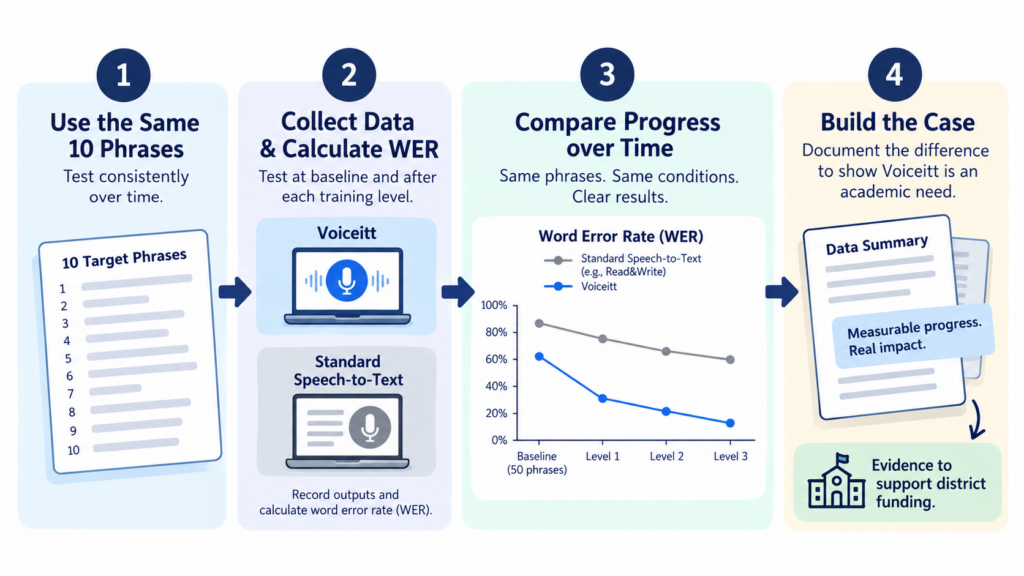
A step-by-step protocol for tracking Voiceitt progress and building the WER comparison data districts need to approve funding. Sep 20, 2026 · by Rachel Khasky-Levy SLPD CCC-SLP In short: Voiceitt gets more accurate as it learns a student’s voice, but you need clean, consistent data to prove it. Test 10 fixed phrases using dictate mode, […]
Voiceitt as a Speech Therapy Tool: Using Biofeedback to Support Communicators With Non-Standard Speech

For many clients, one of the biggest challenges in speech therapy is generalizing learned strategies from structured practice to spontaneous conversation. Voiceitt, an AI-powered speech recognition app designed for people with non-standard or impaired speech, can serve as an effective bridge by giving communicators real-time feedback that mirrors real-world communication. Using Voiceitt for Real-Time Biofeedback […]
Why Voiceitt Accuracy Changes — and How to Improve It

Voiceitt’s personalized speech recognition is designed to adapt to each user’s unique way of speaking. However, accuracy can vary over time — even for users who have been using Voiceitt successfully. Below are the most common reasons accuracy can fluctuate, and practical steps to help restore or improve performance. 1. Changes in Speech Patterns Speech […]
Voiceitt and Apraxia: When Can It Work?
Voiceitt can support individuals with childhood apraxia of speech (CAS), though success depends on sufficient speech consistency for the system to learn. While apraxia is a motor planning disorder that often results in variable errors, disrupted prosody, and reduced intelligibility—especially for unfamiliar listeners—speech is not random, and many individuals demonstrate consistent patterns within certain phonemic contexts, familiar phrases, or word structures. Because Voiceitt is a personalized speech recognition system that learns a user’s unique productions rather than comparing them to standard pronunciation, it may approximate the level of understanding achieved by familiar listeners. Training may require more recordings, careful phrase selection, and patience early on, and progress is often non-linear. Voiceitt can become a meaningful communication support that increases independence and reduces communication breakdowns, provided expectations are realistic, and progress is measured thoughtfully.
My Voice, Recognized at Last

by Taylor Woodard I am a professional social policy analyst who has a physical and speech disability, similar to cerebral palsy. My movements are slow and awkward, requiring the use of a mobility scooter, as well as light daily personal assistance. Further, with my slow speech pattern, I am not easily understood by […]
How Voiceitt Opened Multiple Doors Despite Multiple Sclerosis

By Father Raymond “Ray” Bucko, SJ Living with multiple sclerosis has been a journey full of challenges, but it has also brought unexpected opportunities. This progressive condition has made tasks that many people take for granted—like typing or speaking clearly—nearly impossible for me. However, since discovering Voiceitt, my world has expanded in ways I never […]
It Takes a Village: Maximizing Your Voiceitt Trial with Kids

by Dr. Rachel Levy SLPD, CCC-SLP Voiceitt now only requires 50 recordings to access all features. However, the more effort involved in understanding a child, the more recordings Voiceitt will need to understand their unique speech. Thirty days is not a lot of time to record enough and see Voiceit’s full potentialt, especially when your […]
Unlocking Voice AI with Voiceitt: A Clinician’s Guide to a Successful Trial
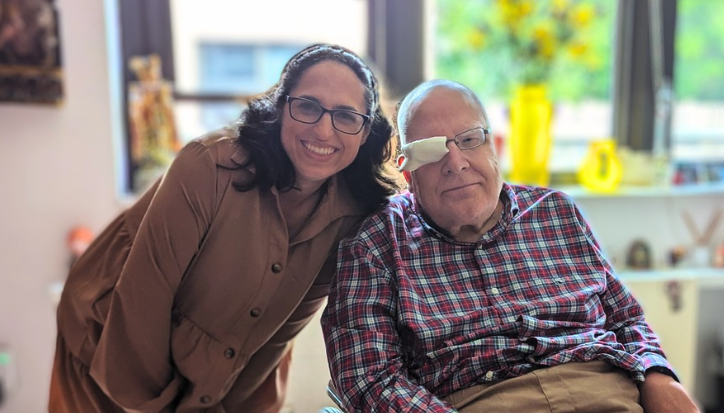
Rachel Levy, SLPD, CCC-SLP, Co-Founder of The Babel Group, visited with Father Raymond Bucko, an active Voiceitt community member. Voiceitt, the leader in speech recognition technology for non-standard speech, accented English, or aging voices as both an Augmentative Alternative Communication(AAC) tool for communicating with others and an Assistive Technology(AT) tool for dictation, home automation, and […]